How Your Zip Code Became Your Identity — And Why That's Costing You
Your Address Is Doing a Lot More Work Than You Think
Take a look at how people describe where they live. Not the physical description — the social one. "We're in the Heights." "It's technically Glendale, but we're right on the border of Pasadena." "It's a Westchester address, but we're close to the city."
Americans are remarkably fluent in the language of residential status. We know instinctively that certain zip codes carry weight, that some street names signal arrival, and that the wrong address can quietly undercut a first impression in ways that are hard to articulate but easy to feel.
This isn't vanity. It's a deeply wired cultural habit with specific historical origins — and it's costing people real money in ways most of us never stop to examine.
The Postwar Blueprint for Address-as-Identity
The roots of residential status anxiety in America run straight through the postwar suburban expansion of the late 1940s and 1950s. Before that era, most Americans lived in cities or rural areas, and the concept of a neighborhood as a social credential was relatively limited in scope.
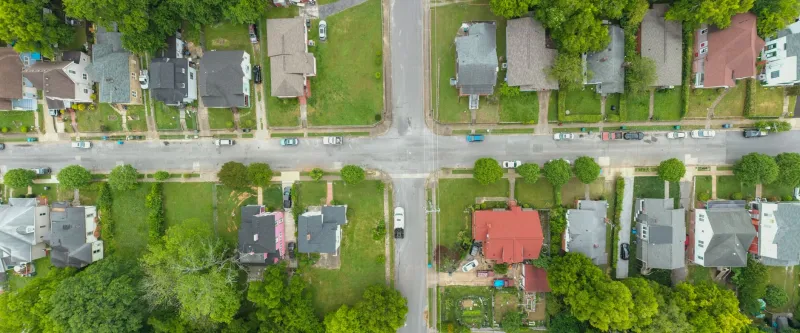
Then the suburbs happened — fast, deliberately, and with enormous government backing. The Federal Housing Administration, the GI Bill, and the rapid build-out of the interstate highway system made it possible for millions of Americans to own homes in newly constructed communities outside city centers. Developers didn't just build houses. They built identities.
Subdivisions were given aspirational names — Sherwood Forest, Briarcliff Estates, Rolling Hills — that evoked old money, English countryside, and natural beauty that often bore no relationship to the actual landscape. Street names were chosen to suggest exclusivity. Marketing materials emphasized the type of person who lived there, not just the features of the house.
 Photo: Sherwood Forest, via cdn.britannica.com
The message was consistent: your address was a statement about who you were and where you stood.
How Marketing Turned a Mailing Location Into a Social Signal
Real estate developers figured out early that they weren't selling square footage — they were selling belonging. The physical house was almost secondary to the social promise that came with it.
This insight has only become more sophisticated over time. Luxury developments create their own internal address systems, sometimes going so far as to petition local governments to rename streets or redefine neighborhood boundaries. "South Beverly Park" and "Beverly Park" are technically different places — a distinction that means almost nothing geographically and millions of dollars symbolically.
 Photo: Beverly Park, via californialuxuryhouses.net
The practice of "address laundering" — attaching a property to a more prestigious nearby neighborhood through creative description — is so common in real estate listings that it barely registers as remarkable. Buyers know it's happening. They participate in it themselves when they describe where they live to others.
Zip codes have become particularly loaded. Marketers, data companies, and financial institutions all use zip codes as proxies for income, education, and lifestyle. Insurance rates, credit offers, and even job callbacks have been shown to vary by zip code in ways that have nothing to do with the individual and everything to do with the aggregate profile of the area.
The Real Financial Cost of Status-Driven Choices
Here's where the cultural habit starts to create measurable financial damage.
Buyers routinely pay significant premiums — sometimes 10%, 15%, or more — for properties in neighborhoods with desirable names or zip codes, compared to nearly identical properties a few blocks away that happen to sit in a less prestigious boundary. The houses are the same. The schools are sometimes the same. The commute is the same. What's different is the social credential attached to the address.
That premium doesn't always translate into better long-term appreciation. In fact, status neighborhoods can be more volatile during downturns precisely because a portion of their value is tied to perception rather than fundamentals. When perception shifts — and it does — the premium can evaporate faster than the underlying value of the property.
Beyond the purchase price, address status influences rental decisions, renovation choices, and even how long people stay in a home that no longer serves their practical needs. People hold onto prestigious addresses longer than makes financial sense because leaving feels like a demotion.
And on the other side: genuinely good neighborhoods with strong fundamentals, reasonable prices, and improving trajectories get overlooked because the zip code doesn't yet carry the right social signal. The buyers who ignore the status noise and focus on the underlying conditions are often the ones who build the most equity.
The Dating Profile, the Job Application, and the Dinner Party
Address status shows up in everyday social life in ways that feel trivial but collectively reinforce the habit. Studies have shown that people list their neighborhood on dating profiles and professional networking sites as a form of social positioning. Mentioning that you live in a certain area of a city carries implicit information — about income, taste, lifestyle, and aspiration — that people are consciously communicating.
Job applicants have reported concern about listing addresses in "wrong" zip codes on resumes, particularly in industries where social signaling matters. Sociologists have documented the discomfort people feel when they move from a high-status neighborhood to a more affordable one, even when the move makes obvious financial sense.
None of this is irrational on an individual level — social perception is real, and it has real consequences. But the collective effect is a housing market where billions of dollars flow toward addresses rather than toward actual quality of life, and where people systematically overpay for a credential that exists mainly in other people's minds.
Rethinking What an Address Actually Means
The habit isn't going away. Status signaling is human, and residential location has carried social meaning in every culture across history. But there's a difference between being aware of the dynamic and being unconsciously controlled by it.
The buyers who tend to make the sharpest decisions are the ones who can separate the status signal from the underlying fundamentals — commute time, school quality, walkability, neighborhood trajectory, actual comparable values — and make a choice based on what those numbers say rather than what the zip code implies.
Your address is a mailing location. The meaning attached to it is something the market — and the developers who built it — mostly invented. Knowing that doesn't make you immune to it. But it might make you a slightly harder person to overcharge.