That Thick Official Appraisal Report on Your Home? It's One Person's Judgment Call in a Trench Coat

Photo: Government of Miami-Dade County, Public domain, via Wikimedia Commons
That Thick Official Appraisal Report on Your Home? It's One Person's Judgment Call in a Trench Coat
When a home appraisal lands in your inbox, it arrives with the visual authority of a legal document. There's a cover page with official certifications. There are tables of comparable sales with addresses and square footage. There are adjustment columns, condition ratings, and multiple signatures. The whole thing looks like it was produced by a process rigorous enough to be used in a courtroom.
And in a sense, it is used in courtrooms. It's also used to approve or deny loans worth hundreds of thousands of dollars, to settle estates, to resolve divorces, and to determine how much house you can actually afford to buy.
So it might be worth knowing what's actually going on underneath all that official formatting.
The Methodology Is Real — The Precision Is Not
Appraisers are licensed professionals who follow standardized guidelines, primarily the Uniform Standards of Professional Appraisal Practice (USPAP). There's genuine methodology involved. They measure the property, review public records, research recent sales of comparable homes in the area, and apply adjustments for differences between those comps and the subject property.
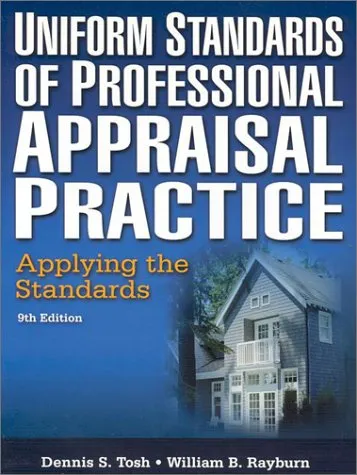 Photo: Uniform Standards of Professional Appraisal Practice, via m.media-amazon.com
Here's where the precision starts to blur: those adjustments are largely judgment calls.
Suppose two homes sold recently in your neighborhood. One has a renovated kitchen and yours doesn't. An appraiser needs to decide how much that kitchen upgrade is worth in dollar terms. There's no table that tells them. They make an informed estimate based on experience and market knowledge — which means a different appraiser, with different experience and different market instincts, might come to a different number.
Multiply that across every adjustment in the report — for square footage differences, lot size, condition, age, upgrades, location within the neighborhood — and the cumulative effect of those judgment calls can be substantial. Studies have consistently found that the same property, appraised by two different licensed appraisers in the same week, can receive valuations that differ by 5 to 10 percent or more. On a $400,000 home, that's a $20,000 to $40,000 range for what is supposedly an objective measurement.
The Appraiser Has Never Met Your House Before
There's something else worth understanding about the process. The typical residential appraisal involves one professional spending one to three hours inside your home — often less. They're looking at condition and features, taking measurements, noting upgrades. They're not running tests, pulling permits to verify work quality, or assessing anything they can't see with their eyes during a single visit.
What they bring to that visit matters enormously. An appraiser who works primarily in a market of older craftsman homes might assess a mid-century modern differently than one who's spent years valuing postwar ranches. Someone unfamiliar with a specific micro-neighborhood might weight a comp from two miles away the same as one from two blocks away, even if local buyers know those markets behave completely differently.
They're also human, which means they're subject to the same cognitive shortcuts everyone is. If they walk in and see a beautifully staged home with fresh paint and flowers on the table, that first impression influences how they assess condition. If they're tired, rushed, or distracted — and appraisers often carry heavy workloads — that affects the time and attention a given assignment gets.
The Pressure to Hit a Number Is Real
Here's the structural problem that doesn't show up in the report at all: the appraisal system has an incentive problem baked into it.
In most residential transactions, the appraisal is ordered by the lender but paid for by the buyer. The lender needs the appraisal to come in at or above the purchase price to justify approving the loan. If appraisals routinely came in below purchase prices, deals would fall apart, lenders would lose origination fees, real estate agents would lose commissions, and the overall transaction volume the industry depends on would shrink.
Before the 2008 financial crisis, this pressure was explicit and documented — lenders and agents sometimes communicated directly with appraisers about where the number needed to land. Post-crisis reforms created more separation between lenders and appraisers through appraisal management companies. But the underlying incentive structure didn't disappear; it just got less direct.
Research from academic economists has found evidence of "appraisal clustering" — a statistically improbable tendency for appraisals to come in right at or just above the purchase price rather than being distributed randomly above and below it the way a truly independent measurement would be. The pattern is consistent with appraisers feeling subtle pressure to support the deal, even without anyone asking them directly.
What You Can Actually Do With This Information
None of this means appraisals are worthless. A professionally conducted appraisal from a qualified local appraiser is still a meaningful data point, and for most transactions it's a reasonable approximation of market value.
But treating it as a precise, neutral measurement — the way a scale measures weight or a ruler measures length — is a mistake.
If you're a buyer and the appraisal comes in low, you have more leverage than you might think. You can request a reconsideration of value, provide the appraiser with comparable sales they may have missed, or ask your lender to order a second appraisal. If you're a seller and an appraisal seems unexpectedly low, it's worth asking which comps were used and whether they were genuinely comparable.
And if you're in any transaction where the appraisal number feels off — too high, too low, or suspiciously round — remember that the thick, certified document you're looking at is, at its core, one professional's best estimate on one particular day. That professional might be excellent. The estimate might be right on target.
But it's still an estimate. The official formatting doesn't change that.