School District Rankings Drive Housing Prices — But Those Scores Might Be Ancient History

The Premium Everyone Pays for Yesterday's News
Walk into any real estate office in suburban America, and you'll hear the same refrain: "Great schools drive property values." Agents pull up GreatSchools.org ratings, point to those coveted 9s and 10s, and explain why that extra $75,000 on the asking price is actually an investment in your child's future.
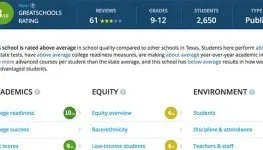 Photo: GreatSchools.org, via www.greatschools.org
What they don't mention? Those ratings you're betting your financial future on might be telling you about a school that existed three years ago.
How School Ratings Actually Get Made
Most homebuyers assume school ratings reflect current reality — like a restaurant review written last week. The truth is messier. GreatSchools, the dominant rating platform that drives billions in housing decisions, typically uses standardized test data that's 2-3 years old by the time it reaches your screen.
Here's how the lag works: Students take state tests in spring. States compile and release results six to twelve months later. Rating companies then process this data into their algorithms. By the time that shiny "9/10" appears on your property search, it's describing test scores from when today's fourth-graders were in second grade.
The pandemic made this delay absurd. Many 2024 school ratings were still reflecting 2019 test scores — meaning families paid premiums based on academic performance from before remote learning, teacher shortages, and massive demographic shifts hit their target districts.
The Metrics Behind the Magic Number
Those clean numerical ratings hide another uncomfortable truth: they're mostly measuring family income, not teaching quality. The primary component of most school ratings? Standardized test scores. And decades of education research shows these scores correlate more strongly with neighborhood wealth than classroom excellence.
Schools in affluent areas consistently rate higher not because they have superior teachers or programs, but because their students arrive with advantages — tutoring, stable housing, college-educated parents, and family resources that support academic achievement. The rating systems know this but haven't figured out how to separate school quality from student demographics.
Some rating platforms try to account for this by including "equity" metrics or comparing schools with similar demographics. But the headline number — that 8/10 driving your housing decision — rarely reflects these nuanced adjustments.
When Reality Doesn't Match the Rating
Consider what happened in Plano, Texas, where families paid premiums for homes in highly-rated school zones. Between 2018 and 2022, several of these schools experienced significant teacher turnover, budget cuts, and program changes. But their ratings, based on older test data, remained high throughout this transition.
 Photo: Plano, Texas, via www.shutterstock.com
Parents who moved there in 2021, expecting the school experience that justified their home's price premium, found overcrowded classrooms, cancelled programs, and stressed faculty. The rating that influenced their quarter-million-dollar decision was describing a school that no longer existed.
This isn't unique to Texas. Across the country, districts experiencing rapid change — whether growth, decline, or administrative upheaval — continue carrying ratings that reflect their past rather than their present.
The Marketing Machine That Obscures Reality
Real estate professionals have little incentive to question school ratings. These numbers provide objective-seeming justification for subjective pricing decisions. When an agent says "This home is priced higher because of the excellent schools," they're typically pointing to data that's both outdated and demographically biased.
Mortgage lenders and appraisers reinforce this cycle. They use school ratings as factors in property valuations, creating a feedback loop where yesterday's test scores influence today's property values, which then justify tomorrow's price premiums.
The Information Homebuyers Actually Need
Smart buyers dig deeper than ratings. They visit schools during regular hours, talk to current parents, and research recent changes in leadership, funding, or programs. They look at teacher retention rates, class sizes, and extracurricular offerings — factors that matter more for their child's experience than test scores from three years ago.
Some districts publish real-time data: current enrollment numbers, this year's teacher-to-student ratios, and recent program additions or cuts. This information is harder to find than a simple numerical rating, but it's far more relevant to the school experience you're actually buying.
The Bottom Line on School-Driven Housing Decisions
Paying extra for good schools isn't necessarily wrong — education matters, and location affects opportunity. But understanding what you're actually buying is crucial. That premium you're paying is often based on information that's outdated, demographically skewed, and disconnected from current school reality.
Before you stretch your budget for a higher-rated district, remember: you're not buying a number on a website. You're buying access to teachers, programs, and resources that exist right now, not the ones that generated test scores years ago. The rating might be history, but your child's education happens in real time.